

The Insider | Volume 1 Edition 3
ESCRS Recap
Copenhagen, Denmark
by Phil Fasone
We had the pleasure of representing the Vision Share network by exhibiting at the 43rd Congress of the ESCRS in Copenhagen, Denmark last month. With over 250 industry partners exhibiting this year, an overwhelming number of attendees from around the world filled the exhibit halls. This year the program featured Instructional Courses, Wetlabs, Video Sessions, Posters and Oral Presentations as well as a variety of other special interests.
I also had the pleasure of participating in the ESCRS first, 5K Charity Run, where over 200 participants ran on a scenic loop through Amager Fælled, a natural reserve near the Bella Conference Center.
This conference has always been a great venue for us to meet with Vision Share clients from Africa, the Middle East, and Europe, and this year did not disappoint. The booth was busy from the start as we met with existing clients and industry partners, as well as new opportunities.
A special thank you to both Tony Dang, Vision Share Manager of Operations, and Brian Keenan, Vision Share Client Development Specialist, for organizing meetings throughout the event, and for representing the Vision Share network with such professionalism.
Extending the Window of Sight: How XTRA4 Could Transform Corneal Transplantation
by Melanie Howell

At Vision Share, we are committed to highlighting innovations that support global sight restoration. Today, we’re putting the spotlight on Moria Surgical’s XTRA4, a next-generation hypothermic storage medium designed to extend corneal preservation. With FDA 510(k) clearance recently granted, XTRA4 allows preservation for up to 14 days.
Why Storage Innovation Matters
Currently, hypothermic storage solutions have a limited practical window for corneal transplantation. In the U.S., many surgeons avoid using tissue stored for longer than seven days, often resulting in unused corneas despite adequate viability. This constraint reduces flexibility, creates logistical challenges, and limits access for patients in need.
What Makes XTRA4 Different
Jana Tothova, Group Head of R&D at Moria, says, “This storage medium is the result of many years of research, testing, and development. By fine-tuning its ingredients, we were able to recreate the physiological conditions of the cornea during storage.“
Read more here – https://visionshare.org/xtra4-corneal-transplant-innovation/
Sal’s visit to Lions Eye Bank of Wisconsin
by Salvatore Moore
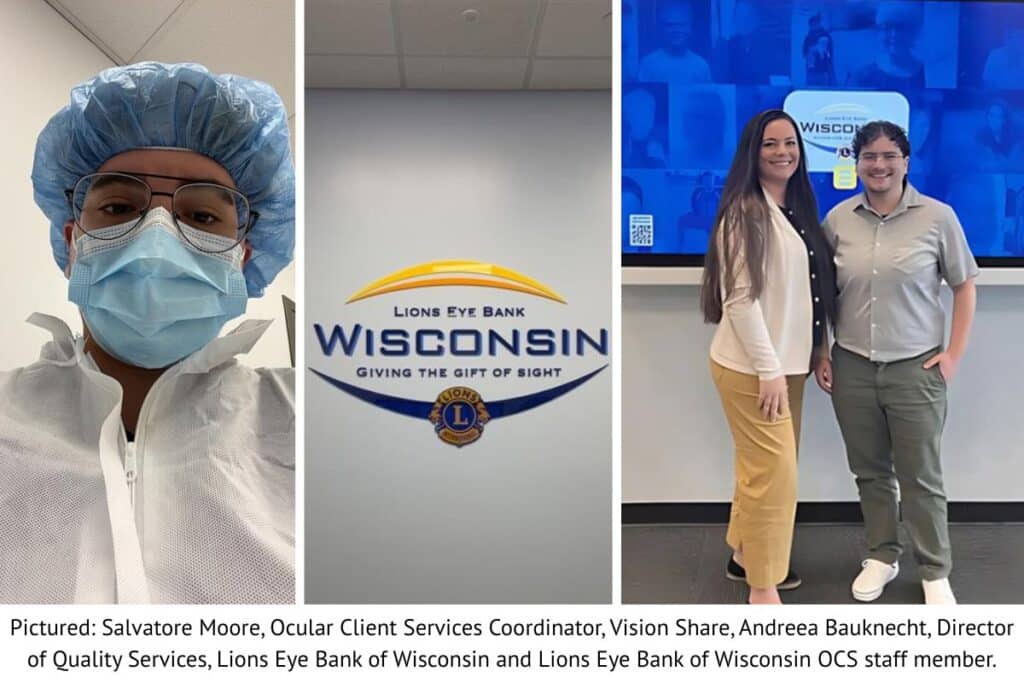
My time at Lions Eye Bank of Wisconsin (LEBW), our member eye bank was a rewarding experience. The staff were very welcoming, and it was great to be able to finally meet everyone in person. I was able to spend time with the processing staff and saw some Preloaded DMEK processing in action. I saw just how steady handed and skillful the processing team must be to manipulate this delicate tissue.
I also got to see the distribution side of things and saw how much goes into getting the tissues out the door. It takes a whole team to verify everything and get it boxed up and ready to go. One of my favorite things was seeing the recovery technicians fine tune their skills by practicing on whole globes. Most importantly, I spent time with the Quality Assurance department and was able to gain knowledge to streamline communications for future projects.
Thank you Stacey Troha, CEO, LEBW, Andreea Bauknecht, Director of Quality Services and LEBW staff for your hospitality. I am very grateful for the time I was able to spend at Lions Eye Bank of Wisconsin.
The Future of Corneal Transplantation: Insights from an Industry Expert
This conversation with Prof. Suphi Taneri, MD is part of a broader series exploring innovation in corneal transplantation. Corneal transplantation is evolving rapidly. From refined surgical techniques to ready-to-use solutions, innovation is reshaping outcomes for patients worldwide. To explore these changes, we spoke with Prof. Taneri, MD, a leading ophthalmologist in Germany, about the most significant advances and what the future may hold for surgeons, patients, and global eye care.
In future posts, we’ll share perspectives from other experts across research, clinical practice, and product development—together building a fuller picture of how breakthroughs are transforming patient care and global access to sight-restoring treatments.
Shifting Indications and Surgical Advances
According to Prof. Taneri, widespread use of corneal cross-linking (CXL) has transformed keratoplasty indications. Progressive keratoconus, once a leading cause of corneal transplant, is now far less common. Instead, endothelial disease (such as FECD and PBK) has become the dominant indication, driving innovation in endothelial-focused procedures.
Techniques like DMEK (and DSAEK where appropriate) are now standard for isolated endothelial failure, offering faster visual recovery, lower rejection rates, and smaller surgical footprints compared to traditional penetrating keratoplasty (PK). Eye banks have also played a key role by providing pre-processed, pre-loaded grafts, improving reproducibility, and reducing surgical time.
Technological Advancements
Some of the technology advancements that are improving every stage of transplantation, according to Dr. Taneri, are:
- Precision Planning: Tools like AS-OCT, Scheimpflug, and intraoperative OCT guide ultra-thin dissections and optimize host-graft interfaces.
- Smarter Insertion Mechanics: Low-shear injectors and pre-loaded DMEK kits help preserve endothelial cells.
- Adjunctive Therapies: ROCK inhibitors, viscoadaptive agents, and new drug delivery systems enhance cell survival.
Ready-to-Use Tissue: Raising the Bar for Outcomes
Prof. Taneri highlighted the transformative role of sterile, shelf-stable, ready-to-use tissues:
Greater Access: Longer shelf life expands treatment options in regions with limited infrastructure.
Consistency at Scale: Standardization reduces variability and raises the floor for outcomes across diverse practice settings.
Efficiency in the OR: Fewer variables and shorter setup times in the OR translate to safer anesthesia windows and surgical throughput.
Read more here – https://visionshare.org/the-future-of-corneal-transplantation-1/
Introducing Our New Hire
by VS Team
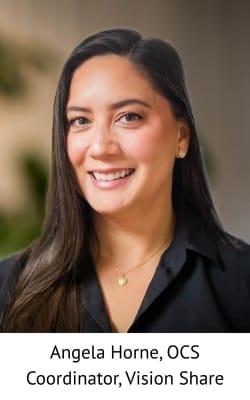
Angela Horne joined Vision Share as our newest Ocular Client Services (OCS) Coordinator in August 2025. As a Board-Certified Optician with a B.S. in Biology from the University of West Florida, she combines her technical expertise with a deep passion for science and vision restoration. In her free time, Angela loves snowboarding and spending time with her family.
Whats Happening Behind the Scenes?
by Tony Dang

Vision Share recently unveiled Access Plus, a new capability in our member portal. Currently available exclusively to Member Eye Banks within the Vision Share network, Access Plus streamlines the tissue-sharing process while maintaining our renowned personalized service.
This quarter, we also focused on strengthening the foundation of our Ocular Client Services Department. We welcomed Angela to our team, ensuring our service operations have the dedicated support they need. In addition, Elizabeth and Salvatore visited Saving Sight and Lions Eye Bank of Wisconsin to gain firsthand insight into day-to-day operations.
These visits provided a deeper understanding of the critical work being done at our member eye banks and will help us streamline processes across the Vision Share network. We are excited to build on this foundation in Q4.
Building Brand Momentum
by Melanie Howell
In Q3, Vision Share partnered with member eye banks to explore new ways of using donor and recipient video stories to raise awareness about eye banking and corneal transplantation. We also worked with industry experts to create educational content for our website and develop resources to support our sales team. To strengthen our digital presence, we refreshed branding across team LinkedIn profiles and aligned on strategies to better engage with both member eye banks and prospective partners.
Operationally, we completed our migration to a new CRM system, which is already helping us automate processes and capture valuable client and lead data. We also launched a brochure showcasing our new sterile tissue solutions and added a website chat app to connect with visitors in real time. These initiatives reflect the strong momentum of Q3 and position us well for continued growth and engagement in Q4.
Research Insights
by Brian Keenan
Artificial intelligence (AI) advantages are that it can learn, reason, perceive and make decisions without being programmed for every task.
Eye banks are increasingly looking to AI for improving the evaluation of cornea tissue for transplantation. There are several areas that are currently applying AI for this purpose. These include automated endothelial cell counting, guttata detection, tissue suitability analysis, and endothelial cell viability analysis. The goal for using AI is to get more accurate results to optimize the donor classification.
Though it is in its early stages, there are obstacles preventing standardized use for eye banks with transplantation. As AI depends on the data that is provided to create clear results, the massive diversity of datasets such as imaging, disease stages, age, ethnicities, different equipment types and more create wide ranging variables that currently create inconsistencies in results. That means for now, clinicians and medical directors need to continue depending on their own diagnostic skills before starting to rely on AI.
In research, AI does provide promising opportunities with donor matching. Donor medical information is being extracted into keywords and offering increased success in matching donors with researchers’ criteria. This doesn’t alleviate the next steps such as imaging for projects, however, it can more quickly and accurately identify potential donors.
Does your eye bank have experience using AI or do you have thoughts about its use or potential? I would love to hear your feedback at bkeenan@visionshare.org.
Looking Ahead
by Phil Fasone
In October, the Vision Share staff will be meeting up in Orlando for our yearly, in-person Staff Meeting. It is the one time of year that we get to meet in person and spend quality time together. Friday, October 17th, Elizabeth Griener, OCS Supervisor, and I will attend the EBAA Forum.
We both look forward to seeing our Membership and industry friends there. Then, on October 18-20, the Vision Share team will exhibit at the AAO Conference at Booth# 1712. If you are attending the conference, we hope you will come by and say hello.
An Update From Our Member Eye Banks
The Eye Bank of Kentucky
The Eye Bank of Kentucky (EBKY) is proud to highlight two recent milestones that demonstrate our commitment to strengthening cornea care and advancing eye banking both locally and globally.
We are delighted to welcome Dr. Brad Tannen as the new Head of Ophthalmology at the University of Kentucky. Dr. Tannen brings a wealth of experience with a strong emphasis on corneal health and transplantation.
His leadership promises to enhance awareness of cornea care in our region and improve access for patients in need of sight-restoring surgery. In addition to his academic and clinical leadership, Dr. Tannen has also joined our Board of Directors as the University of Kentucky liaison, building on our longstanding collaboration with the institution and reaffirming our shared mission of service to patients and communities across the Commonwealth.
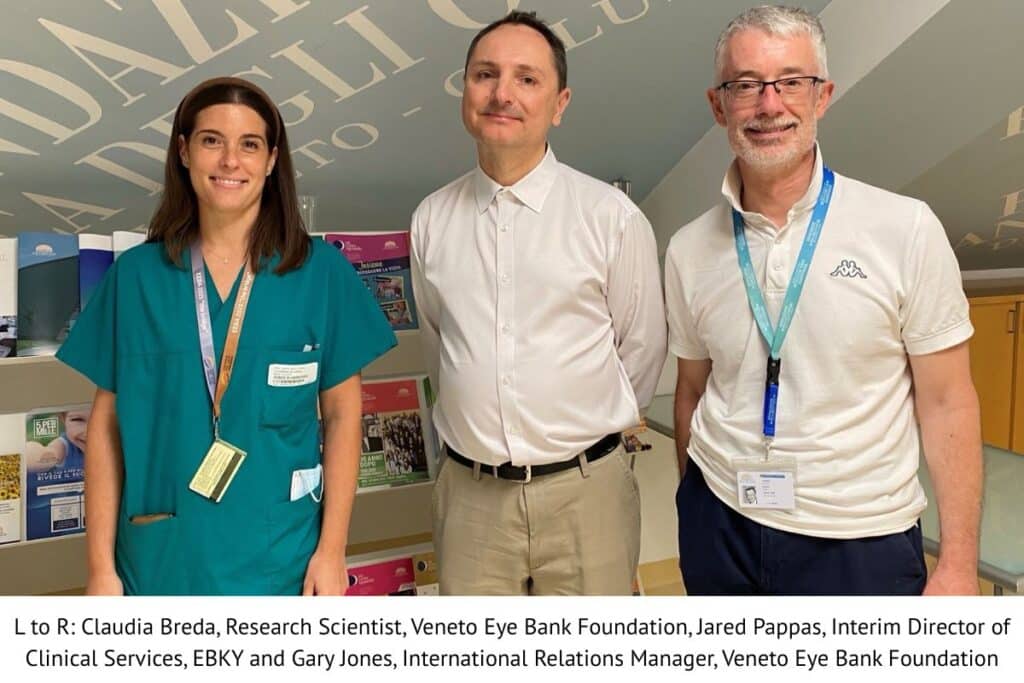
EBKY has also taken important steps to expand its global footprint. This summer, our Interim Director of Clinical Services, Jared Pappas, traveled to Italy to visit the Veneto Eye Bank in Venice. During his time there, Jared toured their eye bank and research laboratories, exploring innovative approaches to restoring sight and advancing corneal research.
He also met with distinguished professionals in the field, including Gary Jones, Dr. Diego Ponzin, Claudia Breda, and Stefano Ferrari. These connections help strengthen our international partnerships while opening doors for future collaboration in both tissue sharing and research.
Together, these advancements reflect EBKY’s enduring commitment: to honor the gift of sight, promote innovation, and ensure that patients everywhere have hope for brighter tomorrows.
VisionFirst
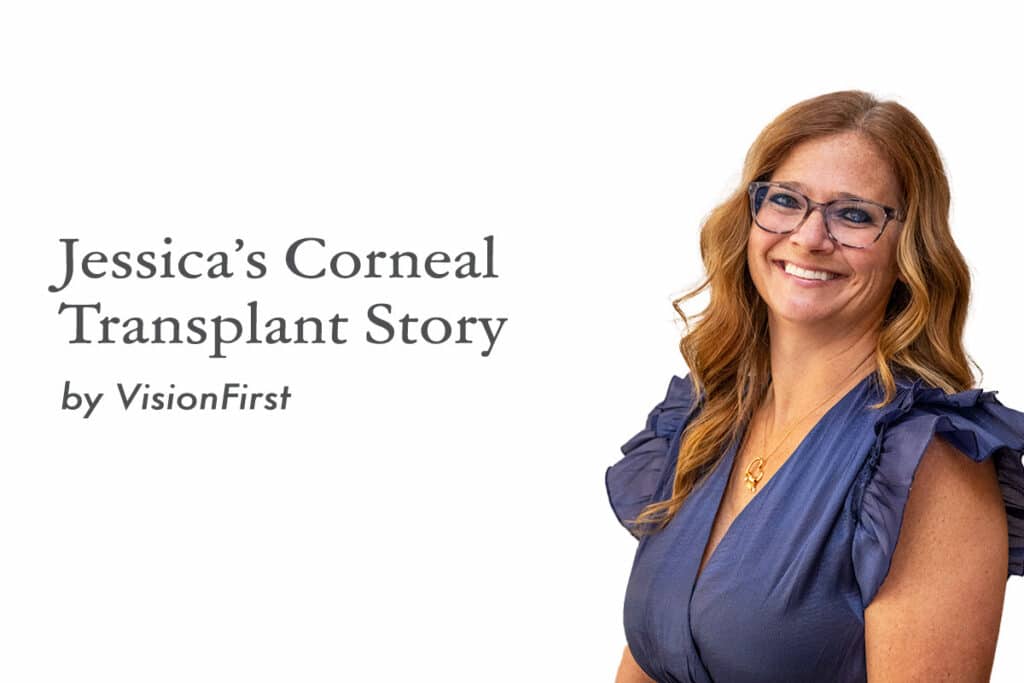
For more than 50 years, VisionFirst has been a trusted partner in eye banking, recognized for compassionate donor family outreach, exceptional surgical support, and an unwavering commitment to the ethical recovery and allocation of ocular tissue. Their mission not only restores vision but transforms lives—just like Jessica’s.
Jessica never expected to hear the words corneal transplant. After spending a weekend helping neighbors with yardwork, she developed irritation that quickly turned into a severe fungal infection beneath her contact lens. Despite intensive treatment—including eye drops every two hours and multiple weekly specialist visits—her condition worsened. Sensitivity to light left her unable to sit in a bright room, and the emotional, physical, and financial toll was overwhelming.
Seven weeks later, her corneal specialist made the urgent decision for transplantation. Jessica left that appointment with a donor cornea—a gift of sight from someone who had chosen to say yes to donation. Having worked as a dental assistant for over 27 years, Jessica understood the impact of tissue donation, having seen donated bone grafts used in her field. While she grieved for her donor’s family, she felt profoundly grateful for their life-giving decision.
Six months later, Jessica required a second transplant. Today, she has returned to work and continues her recovery. At VisionFirst’s Circle of Life Celebration, she bravely shared her journey, offering thanks to her donor families and inspiring others to consider registering as donors. Jessica now advocates for proper contact lens use and spreads awareness of the life-changing power of donation.
